Sixty-five percent of businesses fail within their first decade.
The survivors share something crucial. They’ve cracked the code on systematic customer acquisition and retention through optimized marketing funnels.
Most companies treat their marketing funnel like a leaky bucket. They pour resources into the top while customers drain out the bottom. The result? Wasted budgets and stagnant growth.
We’ve seen this pattern repeatedly with manufacturing companies. They excel at production efficiency but struggle with marketing systems that actually convert prospects into loyal customers.
The solution lies in growth hacking funnel techniques that transform your funnel from a cost center into a revenue engine.
Sixty-five percent of businesses fail within their first decade.
The survivors share something crucial. They’ve cracked the code on systematic customer acquisition and retention through optimized marketing funnels.
Most companies treat their marketing funnel like a leaky bucket. They pour resources into the top while customers drain out the bottom. The result? Wasted budgets and stagnant growth.
We’ve seen this pattern repeatedly with manufacturing companies. They excel at production efficiency but struggle with marketing systems that actually convert prospects into loyal customers.
The solution lies in growth hacking funnel techniques that transform your funnel from a cost center into a revenue engine.
Building Your Growth Hacking Funnel Foundation
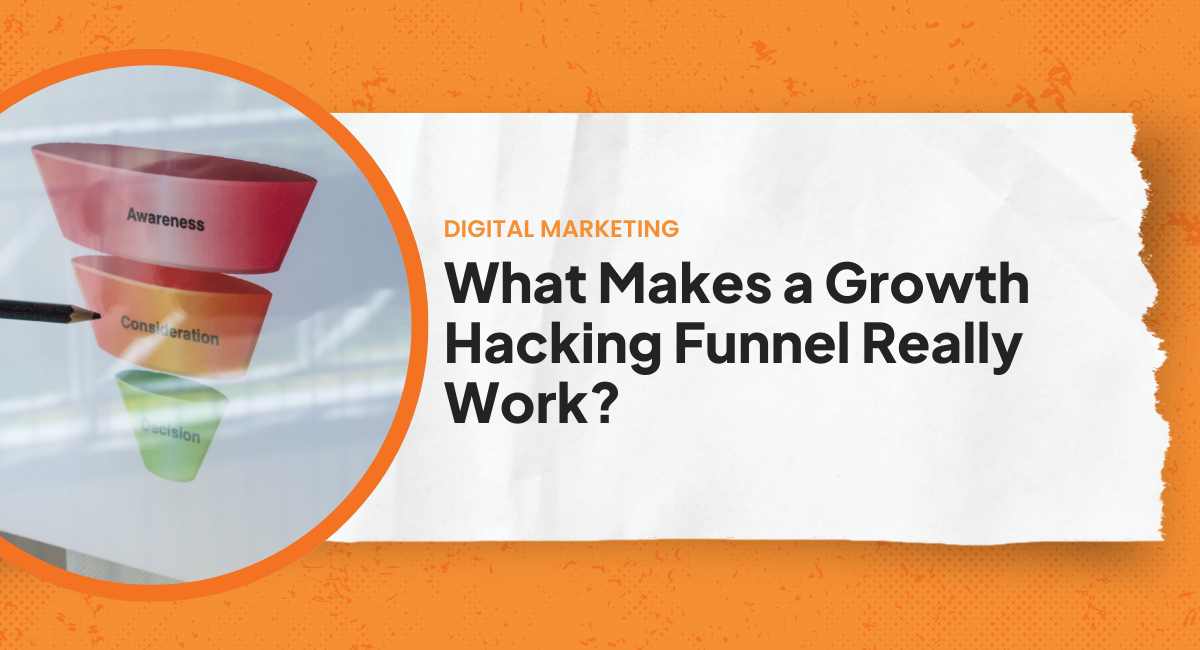
Your marketing funnel operates across three critical stages. Each stage requires different strategies and metrics to maximize effectiveness.
Top-level focuses on brand awareness through strategic digital marketing services. This stage captures attention from potential customers who don’t yet know your company exists. Content marketing, SEO, and paid advertising drive traffic into your funnel.
Mid-funnel handles conversion activities. Prospects evaluate your solutions against competitors. Lead magnets, demos, and nurture sequences guide decision-making during this crucial phase.
Bottom-funnel builds customer loyalty. Existing customers receive retention campaigns, upsell offers, and referral incentives. This stage generates the highest lifetime value per customer.
The magic happens when these stages work together systematically. 79% of leads fail to convert due to poor nurturing, but nurtured B2B leads generate 47% larger purchases at 33% lower cost.
Data-Driven Audience Intelligence
Effective growth hacking starts with comprehensive customer intelligence. You need detailed insights into pain points, purchasing patterns, and product preferences. Gather behavioral data through multiple touchpoints. Website analytics reveal which content resonates most.
Email engagement shows preferred communication styles. Sales conversations uncover objection patterns. Manufacturing lead generation requires understanding these behavioral patterns to optimize conversion rates.
Manufacturing buyers research extensively before making contact. They download technical specifications, compare vendor capabilities, and evaluate case studies. Track these micro-conversions to understand buyer intent.
Create detailed buyer personas based on actual data. Generic demographics won’t drive results. You require specific insights about decision-making processes, budget approval workflows, and implementation timelines.
Survey existing customers about their research journey. What information did they seek? Which content influenced their decision? How long did the evaluation take?
This intelligence forms the foundation for every funnel optimization decision.
The Activation Stage Strategy
Activation represents the crucial transition where prospects engage meaningfully with your brand. They’re not ready to purchase yet, but they’re willing to exchange contact information for valuable content. Newsletter signups indicate genuine interest. Prospects who subscribe want ongoing communication about your industry expertise. Nurture these relationships with consistent, valuable content.
Free demos showcase product capabilities. Manufacturing prospects need to see solutions in action. Offer technical demonstrations that address specific use cases relevant to their operations.
Information requests signal buying intent. When prospects download detailed specifications or request quotes, they’ve moved beyond casual browsing. These leads require immediate, personalized follow-up.
The activation stage may require weeks or months to yield actionable insights. Patience during this phase separates successful companies from those that chase quick wins.
Track activation metrics carefully. Monitor conversion rates from visitor to subscriber, subscriber to demo request, and demo to qualified opportunity. B2B conversion rate optimization depends on measuring these micro-conversions accurately.
Growth Hacking Funnel Optimization Tactics
Industrial advertising campaigns perform best when integrated with comprehensive funnel tracking. Industrial website design should prioritize conversion paths that guide prospects through each activation milestone systematically.
Customer Retention Optimization
Single-purchase customers contribute minimally to long-term success. Repeat buyers drive sustainable growth and profitability. Customer retention delivers exponential returns: a mere 5% increase in retention can boost profits by 25-95%.
Email marketing excels at retention campaigns. Personalized discounts reward loyalty. Welcome messages onboard new customers effectively. Exclusive sale notifications make customers feel valued. Digital strategy services should incorporate automated sequences that nurture customer relationships throughout their lifecycle.
Automation tools handle retention efficiently. Set up triggered campaigns based on purchase history, engagement levels, and lifecycle stage. This systematic approach scales without increasing manual effort.
Create customer success programs that prevent churn. Regular check-ins identify potential issues before they become cancellation reasons. Proactive support builds stronger relationships than reactive problem-solving.
Monitor retention metrics monthly. Track customer lifetime value, repeat purchase rates, and churn patterns. These insights guide retention strategy refinements.
Referral Marketing Systems
Existing customers represent your most powerful acquisition channel. They understand your value proposition and can communicate benefits authentically to similar prospects.
Develop structured referral programs with clear incentives. Financial rewards work, but recognition and exclusive access often motivate just as effectively. Test different approaches to find what resonates with your customer base.
Manufacturing companies often have tight-knit industry networks. A single satisfied customer can influence multiple prospects through trade associations and industry events.
Make referrals easy to execute. Provide customers with simple tools to share your content and introduce your team to their contacts. Remove friction from the referral process.
Track referral sources and conversion rates. Some customers generate higher-quality referrals than others. Identify your best referral sources and nurture those relationships strategically.
Referral marketing reduces the burden on direct marketing efforts while typically delivering higher conversion rates than cold outreach.
Performance Analysis and Optimization
Continuous measurement separates effective growth hacking from random marketing activities. You need systematic analysis to identify which strategies generate the greatest impact.
Set up comprehensive tracking across all funnel stages. Monitor traffic sources, conversion rates, customer acquisition costs, and lifetime values. These metrics reveal optimization opportunities.
Manufacturing sales cycles often span months. Traditional attribution models may miss important touchpoints. Use multi-touch attribution to understand the complete customer journey.
A/B test systematically. Test email subject lines, landing page headlines, call-to-action buttons, and content formats. Small improvements compound over time into significant results.
Review performance data monthly with your team. Identify trends, celebrate wins, and adjust strategies based on actual results rather than assumptions.
Growth hacking techniques reduce customer acquisition costs by 40% and improve ROI by 50% compared to traditional marketing approaches.
Implementation Roadmap
Start with your biggest funnel leak. Most manufacturing companies lose prospects during the nurturing phase between initial interest and sales-ready status.
Week 1-2: Audit your current funnel performance. Identify conversion rates at each stage. Calculate customer acquisition costs and lifetime values. Document your findings.
Week 3-4: Implement tracking improvements. Set up proper analytics, attribution modeling, and conversion tracking. You can’t optimize what you can’t measure accurately.
Week 5-8: Launch your first growth hacking experiment. Choose one technique from this guide and implement it systematically. Email automation or referral programs often provide quick wins.
Week 9-12: Analyze results and scale successful tactics. Double down on what works. Eliminate or modify approaches that underperform.
The key is systematic implementation rather than trying everything simultaneously.
The Competitive Advantage
Companies that master funnel optimization gain sustainable competitive advantages. They acquire customers more efficiently while competitors struggle with expensive, ineffective marketing.
Your prospects research extensively before making contact. Meet them where they are with valuable content and systematic nurture sequences. Guide them through their evaluation process rather than interrupting it.
The manufacturing companies that embrace these systematic approaches will capture market share while competitors remain focused on traditional relationship-building alone.
Growth hacking works because it combines the best of digital marketing efficiency with the relationship focus that manufacturing buyers expect.
The question isn’t whether to optimize your funnel. The question is how quickly you can implement these proven strategies to accelerate your growth.
Key Takeaways
A well-optimized growth hacking funnel can reduce customer acquisition costs by 40% and improve ROI by 50% compared to traditional marketing approaches
79% of leads fail to convert due to poor nurturing, but systematic funnel optimization generates 47% larger purchases at 33% lower cost
Manufacturing companies with structured referral programs and retention strategies see 25-95% profit increases from just 5% improvements in customer retention
Ready to Optimize Your Growth Hacking Funnel?
Transform your marketing funnel from a cost center into a revenue engine. Our proven digital marketing strategies help manufacturing companies achieve measurable growth through systematic funnel optimization.
How long does it take to see results from growth hacking funnel optimization?
+
Most manufacturing companies see initial improvements within 4-8 weeks, with significant results typically emerging after 3-6 months of systematic implementation.
What's the biggest mistake companies make with their marketing funnels?
+
The most common error is focusing only on top-funnel traffic generation while neglecting nurturing and retention stages that drive long-term profitability.
How much should manufacturing companies invest in funnel optimization?
+
Successful companies typically allocate 15-25% of their marketing budget to funnel optimization, with ROI improvements of 40-50% justifying the investment within the first year.
For decades, the formula for growing a manufacturing business was predictable. Industry trade shows, printed catalogs, experienced field sales reps, and referrals built on years of trusted...